Drafting your paper
| Sito: | Attività formative complementari |
| Corso: | BiblioCompass: a guide to bibliographic search and library services for Agricultural Sciences 2025-2026 |
| Libro: | Drafting your paper |
| Stampato da: | Utente ospite |
| Data: | giovedì, 17 settembre 2026, 23:45 |
Descrizione
You have searched through the sources of information at your disposal, selected the most relevant results and evaluated them. Now it is time to start to write your thesis and to organize all the information gathered and used.
1. Introduction
In a scientific work the exposition must be clear and grammatically correct.
It is necessary to respect some editorial rules, which are the rules for a correct presentation of the text.
Each course of study can have its guidelines for theses. Follow their instructions.
Generally, you have to pay attention to:
- a clear and correct presentation;
- rules for citing works of others;
- rules for elaborating a correct bibliography
1.1. Some editorial rules
To obtain a clear and correct presentation, it is necessary to decide how to distribute the content between:
- the body of the text
- the footnotes: the apparatus of notes is an essential component of the scientific character of a work. The footnotes perform the function of providing the necessary information outline, and of reconstructing the path of the logical process followed by the writer.
- there must be no spaces before the punctuation marks
- there must be a space after the punctuation marks
- after an apostrophe at the beginning of a word there must be no space
- there must be no space after an opening parenthesis and before a closing one. The same rule applies to open and closed quotation marks
- every time you decide to go to the end, it is necessary to insert an indent;
- if a dotted abbreviation is placed at the end of a sentence, another period will not be added to indicate the conclusion of the sentence (eg.);
- if you want to emphasize a particular expression, you can use italics; simple quotes can be used to highlight the particular meaning of a term;
- it is preferable to write the numbers in letters;
- for dates it is advisable to write the day and year in Arabic numerals, the month in full with a capital initial; if not written in Roman numerals, centuries must be written with a capital initial; the decades must be written in full in capital letters and it is appropriate, when it is not already clear, to specify the century.
2. Citations and bibliographies
Every scientific work is based on the study of trustworthy sources of information, as we have seen so far. As a consequence, a work is considered of scientific value if it clearly indicates its sources.
In addition to this, if you include others ideas in your work without full acknowledgment, you are stealing someone else’s intellectual property and this is punishable by law in most of the countries, as it is considered a crime, called plagiarism.
There are many programs that can check the presence of plagiarism and most universities use them.
Don’t forget that materials found on the Internet are also protected by copyright laws and must be properly cited and acknowledged.
2.1. What a bibliography is
A bibliography is a list of bibliographical references generally put at the end of a scientific work. It can contain texts that you have cited throughout your work, but also texts that you have used even without citing them, or that you consider milestones for a particular topic.
A bibliography is essential for every scientific publication, because:
you have to give your readers the possibility to follow the path of your research: you have worked a lot for it, why not showing the accuracy and validity of your studies?!
it is ethically correct to give credit to the ones who have studied a certain issue before you and whose results were determinant for your work.
2.2. What a citation is
Bibliography is generally placed at the end of your work. However, it is not sufficient, because you have to signal credits in the body of the text, every time you are referring to somebody else’s work. In this case, you need in-text citations and quotations.
CITATIONS: you cite an author when you use a particular idea from his studies (paraphrase).
QUOTATIONS: you quote an author when you cite the exact words or phrases. In this case, you have to delimit these expressions by quotation marks.
Remember that also images, graphs, tables … must be cited.
Either for citations or for quotations you can include the reference in parenthesis at the end of the expression, or use footnotes, where you can also add some comments and other references.
2.3. How to cite properly: citation styles
Whether you are citing in the body of the text or writing the final bibliography, you need to follow a defined format, a standard, which guarantees that you are including all the elements necessary to identify a resource (for instance author’s name, date of publication etc…).
A citation style dictates the necessary information for a citation and how to order it, as well as punctuation and other formatting.
A citation style is used to recall your sources:
- in the body of the text
- in footnotes
- in your final bibliography
Use the same citation style throughout your entire work.
If you want to find the citation style suggested by your professor, take a look at:
https://editor.citationstyles.org/searchByExample/ using the function "Search by example"
2.4. Citations and references: some examples
Let’s see some examples of in-text citations by using APA style:


Let’s see some examples of in-text citations in footnotes:
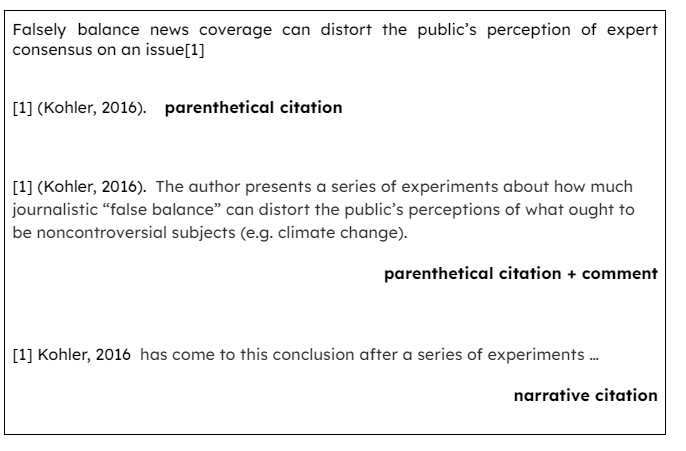
Let’s see the same reference in the final bibliography:

2.5. Reference Management Software (RMS)
Reference Management Software (RMS)
Reference Management Software are programs that can automatically elaborate bibliographies according to citation styles. They gather, organize, manage and share bibliographical references.
They also have an import tool for saving online or on your device bibliographical references found on the Internet or in other sources.
The most common are:
Other RMS and a comparison: https://en.wikipedia.org/wiki/Comparison_of_reference_management_software
The following guides will help you understand how to use EndNote and Zotero.